China’s 5l Electric Pressure Cooker industry sits at the intersection of smart cooking, compact kitchens, and export manufacturing. The five-liter format suits family meals, meal preparation, and restaurant-style batch cooking without demanding excessive counter space. Market estimates vary. That matters.
Reports from Euromonitor International’s Consumer Appliances research and Statista’s electric cooking appliance data highlight steady demand for convenient, energy-conscious kitchen equipment. Their findings also point toward online retail, urban lifestyles, and multifunctional appliances as important market influences. Meanwhile, the China Household Electrical Appliances Association regularly emphasizes manufacturing scale, product safety, and technology upgrades across China’s home-appliance sector. These sources do not produce one identical market figure, but they provide useful direction.
This guide examines China’s top 10 suppliers through practical procurement criteria. These include pressure-control design, inner-pot materials, heating consistency, factory certifications, customization ability, minimum order quantities, and after-sales support. A reliable supplier should explain its testing process clearly. Ask for documentation, not attractive promises.
A five-liter cooker should maintain stable pressure, release steam predictably, and keep its handle comfortable after repeated use. Small details matter, such as readable control labels and a removable sealing ring that does not retain food odors. Suppliers with automated production lines may offer stronger consistency, but automation alone does not prove quality. No ranking is perfect. Buyer requirements differ by market, voltage, language, and compliance expectations.
The selected companies are therefore compared with caution. Their strengths may change as product lines, certifications, and export strategies develop. Readers should verify current factory records, sample performance, and independent test reports before placing an order. That final check is easy to skip. It should not be.
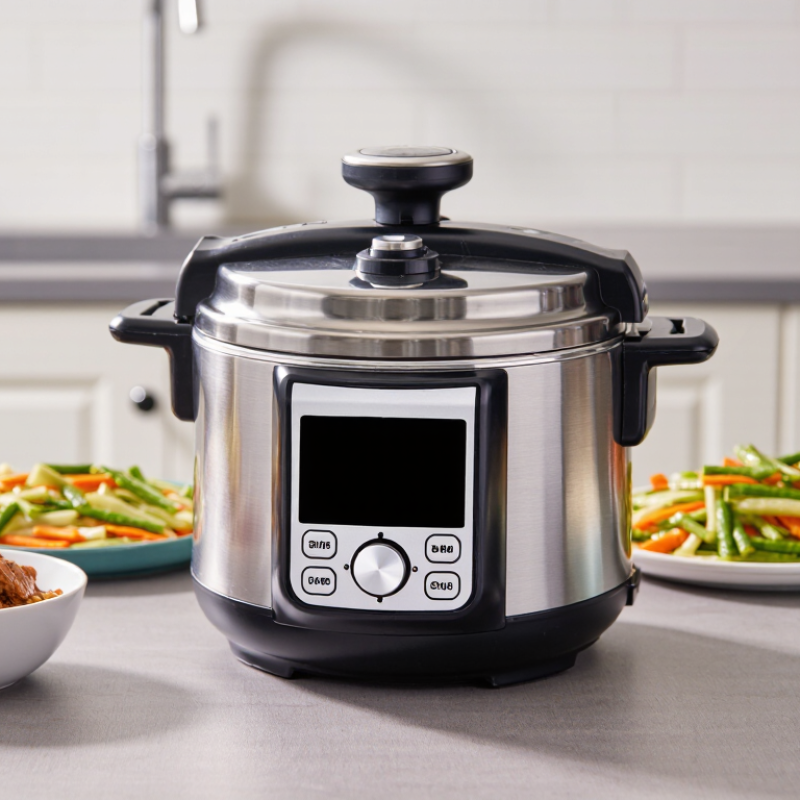
China Top 10 5L Electric Pressure Cooker Suppliers?
What Defines a High-Quality 5L Electric Pressure Cooker Supplier in China
A high-quality 5L electric pressure cooker supplier offers more than a polished sample. IMARC Group reported that the global electric pressure cooker market reached about USD 4.5 billion in 2023. This growth increases pressure on Chinese suppliers to prove consistency, not just production capacity. Buyers should inspect heating accuracy, pressure stability, sealing performance, and control-panel durability. Small details matter. A reliable supplier records temperature deviations during repeated cooking cycles. It also keeps batch numbers for heating plates, sensors, valves, and inner pots.
Technical compliance deserves equal attention. Suppliers should test products against relevant requirements in IEC 60335-2-15 and provide traceable laboratory records. Their factories should explain how they control silicone-ring compression, overpressure protection, and steam release. A 5L cooker may look strong, yet weak valve machining can create long-term problems. Factory audits should review incoming-material checks, assembly inspection, and finished-product sampling. ISO 9001 certification can support confidence, but it does not replace physical verification. Numbers matter. Ask for failure rates and corrective-action records. Not every supplier will share them clearly. That hesitation deserves reflection. A responsible partner accepts independent testing, documents design changes, and admits where its process still needs improvement.
Anonymous supplier comparison based on practical OEM/ODM, product-safety, manufacturing, and export-performance criteria for 5L electric pressure cookers
| Rank | Anonymous Supplier Profile | Typical OEM/ODM Experience | 5L Product Configuration | Rated Power | Working Pressure | Inner Pot Options | Safety System | Certification Support | Typical MOQ | Typical Lead Time | Quality Indicators | Overall Score |
|---|---|---|---|---|---|---|---|---|---|---|---|---|
| 1 | Supplier Profile 01 | 15+ years | 5L digital multi-function model | 1,000W | 70–80 kPa | 304 stainless steel; non-stick option | Multi-level pressure release, lid lock, overheat protection, float valve | CE / CB / RoHS available | 500 units | 35–45 days | Incoming, in-process, electrical, pressure, and aging tests | 9.3 / 10 |
| 2 | Supplier Profile 02 | 12+ years | 5L programmable pressure cooker | 900–1,000W | 60–70 kPa | 304 stainless steel; ceramic option | Pressure regulator, thermal fuse, anti-block shield, automatic pressure release | CE / EMC / LVD support | 800 units | 40–50 days | 100% electrical safety testing and sample pressure testing | 9.1 / 10 |
| 3 | Supplier Profile 03 | 10+ years | 5L stainless-steel inner-pot model | 1,000W | 70 kPa | 304 stainless steel; 3-ply base | Double pressure-control system, lid-position sensor, overheating protection | CE / CB / LFGB material support | 1,000 units | 40–55 days | Traceable components and documented final inspection | 8.9 / 10 |
| 4 | Supplier Profile 04 | 8+ years | 5L Wi-Fi-ready smart model | 1,000W | 60–80 kPa | Aluminum alloy with non-stick coating | Electronic pressure control, lid lock, temperature sensor, backup thermal fuse | CE / RED / RoHS support | 1,000 units | 45–60 days | Firmware testing, EMC pre-checks, and production-line inspection | 8.8 / 10 |
| 5 | Supplier Profile 05 | 10+ years | 5L mechanical-control model | 900W | 50–70 kPa | Aluminum alloy; stainless-steel option | Mechanical pressure regulator, safety valve, anti-overpressure system | CE / GS documentation support | 500 units | 30–40 days | Simple architecture with routine pressure and insulation testing | 8.6 / 10 |
| 6 | Supplier Profile 06 | 7+ years | 5L compact countertop model | 900W | 60–70 kPa | 304 stainless steel; ceramic-coated option | Steam-release control, thermal protection, lid-lock indicator | CE / RoHS available | 1,000 units | 35–50 days | Functional testing, appearance inspection, and carton drop testing | 8.4 / 10 |
| 7 | Supplier Profile 07 | 6+ years | 5L multi-cooker with preset menus | 1,000W | 60–80 kPa | Aluminum alloy with food-contact coating | Pressure sensor, temperature limiter, anti-blocking valve | CE / EMC / LVD support | 1,500 units | 45–60 days | Menu-function verification and batch sampling inspection | 8.2 / 10 |
| 8 | Supplier Profile 08 | 8+ years | 5L export-oriented standard model | 900–1,000W | 50–70 kPa | 304 stainless steel; standard non-stick option | Pressure limiter, safety lock, overheat cut-off, controlled steam valve | CE / CB / RoHS support | 1,000 units | 35–50 days | Routine production audits and pre-shipment inspection | 8.1 / 10 |
| 9 | Supplier Profile 09 | 5+ years | 5L entry-level digital model | 900W | 50–60 kPa | Aluminum alloy with non-stick coating | Basic pressure regulator, thermal fuse, lid safety interlock | CE / RoHS documentation available | 1,000 units | 30–45 days | Electrical safety, leakage-current, and basic pressure tests | 7.8 / 10 |
| 10 | Supplier Profile 10 | 5+ years | 5L private-label basic model | 800–900W | 50–60 kPa | Aluminum alloy; stainless-steel upgrade available | Thermal protection, pressure valve, manual steam release, lid lock | CE / EMC support | 500 units | 30–45 days | Standard QC checklist and pre-shipment sampling | 7.6 / 10 |
Note: A 5L electric pressure cooker generally refers to a nominal pot capacity of approximately 5 litres. Actual MOQ, lead time, power rating, pressure setting, coating specification, testing scope, and certification availability should be confirmed through current quotations, technical datasheets, samples, and third-party compliance reports before purchasing.
A reliable supplier controls heating accuracy, pressure stability, sealing, and panel durability. Small details matter. It records temperature differences across repeated cooking cycles. Batch numbers should identify key components.
Ask whether 5L means total capacity or usable capacity. A 5L inner pot may safely hold less food. Request drawings and measurements. Test the pot with water, rice, or beans before placing a large order.
The supplier should explain pressure control, lid locking, steam release, and overpressure protection. Ask for test records covering the exact model. Similar models are not enough. A strong-looking valve can still have poor machining.
Request samples from two different production batches. Compare cooking time, pressure recovery, steam release, and lid movement. Record everything. A factory may pass one batch and disappoint on the next.
Review incoming-material checks, assembly inspections, and final-product sampling. Ask for failure rates and corrective-action records. Clear batch identification helps trace heating plates, sensors, valves, and inner pots. Missing records deserve reflection.
No. Certificates can support confidence, but they do not replace physical verification. Confirm the factory, model, and production date. Independent testing is useful. A certificate may not reveal weak cleaning access or poor finishing.
Ask about manuals, packaging, control settings, spare sealing rings, and firmware adjustments. Confirm minimum order quantities and warranty handling. Support should be practical. Polished promises are not enough.
Use the same checklist for at least three suppliers. Compare samples, tolerances, delivery schedules, inspection procedures, and communication quality. Do not trust catalog images alone. They can hide rough edges, weak cords, or difficult cleaning areas.
This guide provides a practical overview of China’s top 10 suppliers of 5l Electric Pressure Cooker products, focusing on the standards that define a reliable manufacturer. A high-quality supplier should offer stable production capacity, strict quality control, food-contact-safe materials, dependable safety systems, and consistent performance across large orders. Leading suppliers commonly provide features such as programmable cooking functions, multiple pressure settings, digital controls, durable inner pots, automatic temperature regulation, and protection against overheating or excessive pressure.
The article also explains how buyers can compare suppliers by reviewing pricing, certifications, manufacturing experience, customization options, testing procedures, delivery schedules, and after-sales support. Selecting the right partner requires balancing cost with product quality, compliance, communication, and long-term reliability. By evaluating samples, factory capabilities, documentation, and production consistency, importers and distributors can make a more informed decision and choose a Chinese supplier that matches their target market and business requirements.

 Zhenmei Electrical